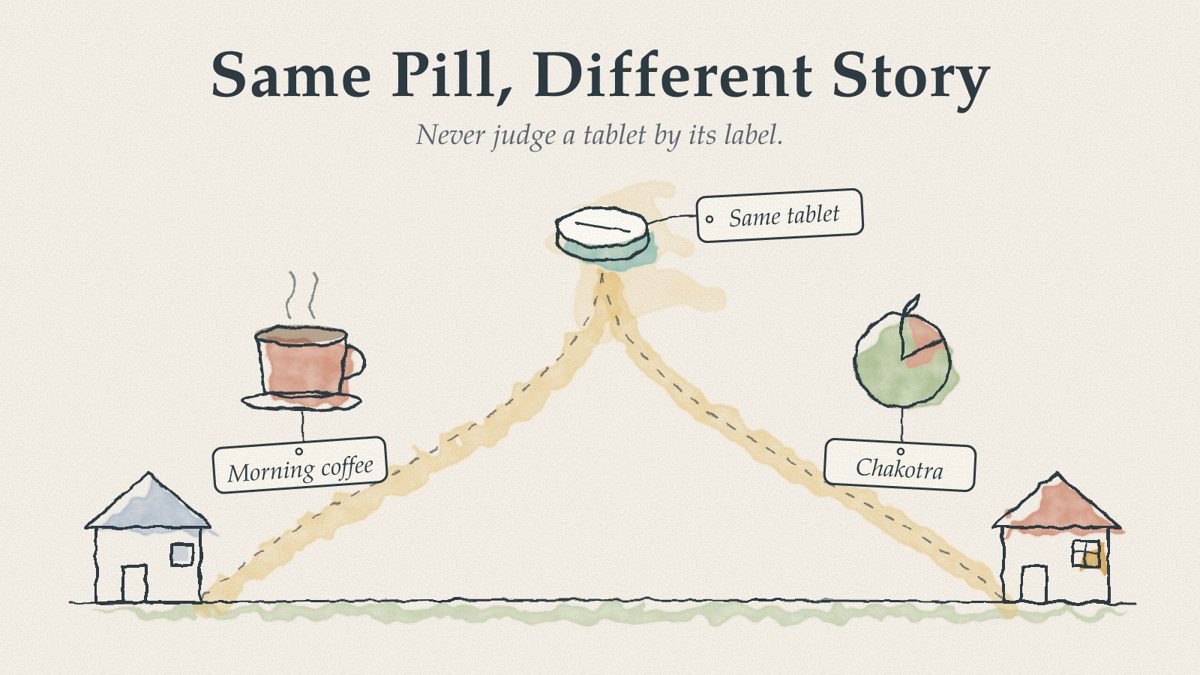
Two neighbours in the same colony. Same age, same doctor, same tablet. One says, "Doctor, this medicine is wonderful." The other says, "Doctor, nothing is happening." And both are telling the truth.
So who is wrong? Nobody, really. Let us look at this differently.
Two grey ticks and a reply
Every medicine has two halves to its life. Pharmacokinetics is what your body does to the medicine: how it is absorbed, spread, broken down and removed. Pharmacodynamics is what the medicine does to your body: which switches it presses and how strongly your body answers.1
Think of a WhatsApp message to your aunt. Two grey ticks: the message was sent, delivered, and is sitting in her chat. That is pharmacokinetics, the journey. What your aunt does after reading it, whether she calls back, forwards it to forty relatives or ignores it, that is pharmacodynamics, the job.
Where it breaks: your aunt decides; a medicine decides nothing. Your body's chemistry does that, quietly.
Now, think about it. When a medicine "does not work", the problem can sit in either half: the message was never properly delivered, or the house simply answered differently.
The road from your mouth to your blood
A swallowed tablet has to travel. On its way into the blood it passes the gut wall and the liver, which break down part of it first. Doctors call the share that finally arrives in the blood bioavailability2. Under the tongue, through the skin or by injection, a medicine skips part of that road.
The liver is the main processing plant, the kidneys the main exit, and their speed varies with your genes, age and whatever else you swallow.1
Your morning coffee and your thyroid tablet
Say, for example, a lady takes her thyroid tablet at 6.30 a.m. and her filter coffee at 6.35. The tablet may want to say, "Amma, I have not even found a seat in the bus and you have already sent the coffee after me."
The usual advice for levothyroxine is an empty stomach, plain water, and 30 to 60 minutes before breakfast. In a small study of thyroid patients and volunteers, coffee swallowed along with the tablet cut absorption by roughly a quarter to a third, while coffee taken an hour later made no difference.3 A small study, so hold the number gently, but the message is simple: give the tablet its head start. Calcium and iron are usually kept about four hours away too.
Chakotra, greens and the cigarette you quit
Some foods and habits change the journey of a medicine. Grapefruit and its cousin chakotra (pomelo) can raise the level of certain medicines. Quitting smoking can raise others. With warfarin, the steadiness of your vitamin K intake matters more than avoiding greens.
Chakotra. Grapefruit contains natural compounds that switch off one of the gut wall's main medicine-processing enzymes. A review in the Canadian Medical Association Journal counted more than 85 medicines that interact with grapefruit, 43 of them with possibly serious effects. One fruit or one glass of juice can be enough, and the effect lasts for hours. Pomelo, our chakotra, and Seville oranges carry the same compounds; ordinary sweet oranges do not.4 So the same dose can behave like a bigger one.
Quitting smoking. Smoking speeds up a liver enzyme that clears caffeine and some psychiatric medicines such as clozapine and olanzapine. New Zealand's medicines regulator notes that smokers clear caffeine more than 50% faster. When someone quits, that extra speed fades, and caffeine and these medicine levels can climb.5 Wonderful decision, quitting. It just needs a call to your doctor.
Greens on warfarin. Warfarin works against vitamin K, so many people on it nervously push palak and methi off the plate. But the advice is consistency, not avoidance. In a small trial presented at a nutrition conference, people whose blood thinning had been unstable became more stable when they steadily ate more vitamin K.6 Early data, not the final word. The real trouble is the sudden swing: no greens all week, then a saag feast on Sunday.
Same message, different house
Now the second half. Even with the same blood level, bodies answer differently. Medicines work largely by fitting into receptors, which are like door locks on our cells. Some are duplicate keys that open the door; others fit but do not turn, blocking the body's own key.
Take clopidogrel, a common heart medicine that only works after a liver enzyme switches it on. In a study of over 44,000 British South Asians, 13% had two weak copies of that enzyme's gene, compared with 2.4% of Europeans, and those people on clopidogrel had more than three times the risk of a repeat heart attack.7 Indian studies are smaller and mixed, so this is your cardiologist's call, not yours alone.
Age changes both halves: older bodies often clear medicines more slowly and feel some, like sleeping tablets, more strongly. Hence the Beers Criteria, a list of medicines to use carefully in older adults.8
And my favourite part: your lifestyle is a kind of medicine too. Sharply cut carbohydrates or lose weight while on insulin, certain diabetes tablets or blood pressure medicines, and the old dose can overshoot into low sugar or low pressure. Good news, actually. It just means your doctor must review the dose with you.
Remember Sanjeevani? Hanuman racing the mountain back before sunrise is the journey; the vaidya Sushena picking the right herb for Lakshmana is the job. Where it breaks: the epic needed one heroic dose; real medicines need steady, measured ones.
What to take away
- Take your thyroid tablet as the label says, with plain water on an empty stomach, and give it a head start before coffee or tea.
- Ask your pharmacist or doctor one question for every new medicine: "Does this clash with chakotra or grapefruit?"
- On warfarin, keep your greens steady through the week rather than cutting them out or feasting on them suddenly.
- Quitting smoking, changing your diet sharply or losing weight while on diabetes or blood pressure medicines? Tell your doctor, so the dose can keep pace.
- Keep one written list of everything you take, including supplements and home remedies, and show it at every visit.
When to see a doctor
- Never stop, double or change a medicine without the doctor who prescribed it. Some medicines rebound when stopped suddenly.
- On diabetes medicines: shakiness, sweating, confusion or unusual drowsiness can mean low sugar. Treat it as your doctor taught you and seek help.
- On blood thinners: unusual bruising, bleeding gums, blood in urine, or black stools need a doctor the same day.
- Dizziness or fainting after a medicine change, a new diet or quitting smoking.
- Swollen face or lips, difficulty breathing, chest pain or collapse: call 112, or 108 for an ambulance, straight away.
The tablet is the same. The story is yours.
Your doctor writes the prescription. But the cup beside each tablet, the fruit after it, the cigarette you finally let go of, you write that part every day. Tomorrow morning, simply notice what travels with your tablet. Come witness how much of the story you were already writing.
References
- StatPearls. Pharmacokinetics. NCBI Bookshelf. https://www.ncbi.nlm.nih.gov/books/NBK557744/
- StatPearls. Bioavailability. NCBI Bookshelf. https://www.ncbi.nlm.nih.gov/books/NBK557852/
- Benvenga S, et al. Altered intestinal absorption of L-thyroxine caused by coffee. Thyroid. 2008;18:293-301. https://doi.org/10.1089/thy.2007.0222
- Bailey DG, Dresser G, Arnold JMO. Grapefruit-medication interactions: forbidden fruit or avoidable consequences? CMAJ. 2013;185:309-316. https://pmc.ncbi.nlm.nih.gov/articles/PMC3589309
- Medsafe New Zealand. Smoking interacts with medicines. 2013. https://medsafe.govt.nz/profs/PUArticles/December2013SmokingInteractMedicines.htm
- American Society for Nutrition. Eating more vitamin K found to help, not harm, patients on warfarin (Nutrition 2019). https://nutrition.org/eating-more-vitamin-k-found-to-help-not-harm-patients-on-warfarin/
- Magavern EF, et al. CYP2C19 genotype prevalence and association with recurrent MI in British-South Asians treated with clopidogrel. JACC: Advances. 2023;2:100573. https://doi.org/10.1016/j.jacadv.2023.100573
- 2023 AGS Beers Criteria Update Expert Panel. J Am Geriatr Soc. 2023;71:2052-2081. https://doi.org/10.1111/jgs.18372
Educational information only, not diagnosis, treatment or emergency care. Please speak to a qualified doctor before changing medicines, diet or treatment.